
'The bottom line is that at least now we should take an honest look at this business of NSG membership (or Masood Azhar for that matter.),' says Ambassador M K Bhadrakumar.
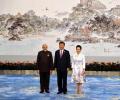
'By crudely dragging the topic into the bazaar to flog it for momentary pleasure, we turned it into a dead carcass by the time Modi even got back from Xiamen,' says Ambassador M K Bhadrakumar.

General Bajwa, who commanded the 10 Corps that looks after Pakistan's border with India, is unlikely to change his army's and nation's policy on Kashmir,' says Ambassador M K Bhadrakumar.

'Clearly, the Modi government is proving to be far more willing than any previous government in Delhi to hitch India's wagons with the US' regional strategies.'

'The surge of Saudi nationalism is the last thing Washington wants,' says Ambassador M K Bhadrakumar.
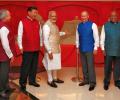
'The crux of the matter is that our narrative lacks credibility with world capitals,' argues Ambassador M K Bhadrakumar.
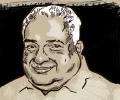
Mr T V R Shenoy, who contributed columns to Rediff.com from its birth, passed into the ages on Tuesday evening. As we grieve and mourning his passing, Ambassador M K Bhadrakumar bids adieu to an unusual human being, a sage for our times.

'The most striking thing about the US strike on Syria is its futility of purpose beyond a symbolic value to impress the domestic constituency that Trump is a forceful decision-maker,' says Ambassador M K Bhadrakumar.
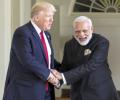
'The Modi government would chaff at the very idea of holding talks with Pakistan, facilitated by Washington and under close US monitoring, when the 2019 poll is sailing into view.' 'But in politics and diplomacy, there may be moments when drinking from the chalice of poison is necessary,' says Ambassador M K Bhadrakumar.

'India stands to gain immensely by forging a developmental partnership with China.' 'While through sustained strategic communication there is scope to steadily expand the commonality of interests between the two countries.' 'This is also a practical way to ensure that differences do not get over-magnified and become disputes,' says Ambassador M K Bhadrakumar.

'Alas, the Congress party offers no suggestions as to how to unscramble the omlette it cooked during 2004-2014 on which the Modi government may have since lavishly spread some tomato ketchup,' says Ambassador M K Bhadrakumar.

'If the US intention was to use the FATF platform to isolate Pakistan and impose sanctions against it, that is not going to work when influential countries such as Turkey, Iran, Saudi Arabia, China and Russia will not lend support to the US campaign,' says Ambassador M K Bhadrakumar.
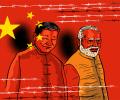
'An opportunity is at hand to think big and recast the India-China relationship on a new template, which would help the pursuit of our country's dream of major power status,' says Ambassador M K Bhadrakumar.

'Pakistan's main objective will be to shepherd India toward resumption of talks, preferably with American monitoring.'
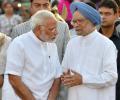
Singh issued a statement on Monday, listing those who attended the dinner, and stressed that the election was not discussed during the meeting.
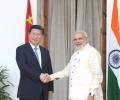
'It needed political courage on the part of the prime minister to make such an intervention at the present juncture when the hawkish opinion rules the roost in the Indian foreign-policy discourses in our media, and, unfortunately, the sane voices have largely fallen silent,' says Ambassador M K Bhadrakumar.
'It will be foolhardy to overlook that this stunning shift in China's stance comes as the culmination of the severely damaged India-China relationship under the present government,' says Ambassador M K Bhadrakumar.

Iran signed a $3 billion deal with Boeing, backed Qatar against the Saudis, scored a big victory in Syria and reached out to Hamas. Ambassador M K Bhadrakumar examines how the Qatar versus Saudi Arabia standoff is quickly changing alignments in the Middle East.

'Modi's abject capitulation will play out badly in his core constituency.' 'The bulk of our strategic community is under the impression that India under Modi has already become a superpower.' 'They don't even want to look at the country's emaciated limbs or its asthmatic problems,' says Ambassador M K Bhadrakumar.

A vilification campaign against Rosneft has begun in right earnest, says M K Bhadrakumar.

'Modi's decision to hold out an olive branch to Sharif within 48 hours of the 'surgical strikes' has been a timely move as it helps tensions to 'de-escalate',' says Ambassador M K Bhadrakumar.

'Here in Delhi, the Modi government is supposedly looking at 'options' to hit back at Pakistan in any whichever way it can, while in Washington, the Obama administration is looking for ways to strengthen US military cooperation with Pakistan,' says Ambassador M K Bhadrakumar.
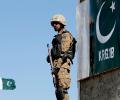
'If push comes to shove, Pakistan does have the capability to make it difficult for the US and NATO forces to make even a withdrawal of troops out of Afghanistan in orderly fashion,' says Ambassador M K Bhadrakumar.

'All the political parties, should in order to deal with China, come together and formulate strategies to safeguard every single inch of Bharat.' RSS leader Indresh Kumar tells Prasanna D Zore/Rediff.com why the Sangh wants the Modi government to convene an all-party meeting on the Chinese incursions into Indian territory.

India-Israel relations are at a crossroads. Simply chanting old hackneyed mantras on terrorism, secularism, democracy, et al, won't suffice. There is danger of stagnation setting in, says Ambassador M K Bhadrakumar.

'The Communist rule in Tripura was exceptional while it lasted for a quarter century in giving good governance.' 'The chief minister himself was the paragon of virtues in his dedication in public life.' 'But all that still didn't add up when the BJP's dream merchants came up with their famous 'development agenda'.' 'One thing that emerges indisputably in the Tripura election results is that needs and aspirations more or less narrow down to one little word -- jobs,' says M K Bhadrakumar.

'Unsurprisingly, the joint statement issued after Modi's visit contains a paragraph on terrorism.' 'It is on the usual lines that India would have with, say, Croatia.' 'The surprising part is that it shies away from getting into specifics,' points out Ambassador M K Bhadrakumar.

'The real challenge cannot be underestimated considering that this is still very much a "boutique relationship" -- a transactional relationship at its core based on its utility value to both countries -- but enveloped in an aura of romance,' says Ambassador M K Bhadrakumar.
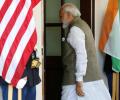
We see none of the euphoric build-up customary to India's encounter with US presidents in recent times. This gives Modi wriggle room to work on the much-needed reset of India-US ties.

'Make no mistake, depriving water deliberately to a nation of 190 million people is a repugnant idea.' 'The world community won't forgive us.'

'Did Trump hint at US military intervention in Qatar?' asks Ambassador M K Bhadrakumar.

'Every single American act to weaken Syrian forces would only tilt the military balance in favour of ISIS whom Trump pledges to vanquish from the face of the earth,' says Ambassador M K Bhadrakumar.
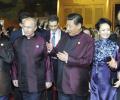
The American, Russian and Chinese reactions to the Uri attack indicates how tough it will be for India to 'isolate' Pakistan internationally,' says Ambassador M K Bhadrakumar.

'The danger today is that out of sheer fatigue and exasperation, the US might cut loose and exit from Afghanistan leaving it to the region to cope with the debris, which it is ill-equipped to handle,' says Ambassador M K Bhadrakumar.
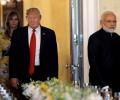
'China was the elephant in the Oval Office and Trump would have sensed that Modi's foreign policy architecture has become disoriented sans the US' pivot to Asia,' points out Ambassador M K Bhadrakumar.
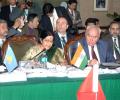
'The truly amazing part is the influence that Washington wields over Modi and the Sangh Parivar,' says M K Bhadrakumar. 'What explains it? The Americans know precisely well which raw nerve to touch and how to make the Sangh Parivar, Modi and this government perform the trapeze act.'

Intolerance toward the minority communities or attempts to humiliate them or the refusal to go the extra league to build an inclusive society -- these are all evident today in our society, says Ambassador M K Bhadrakumar.

Although Suu Kyi has won an overwhelming victory, it is not going to be easy to translate this victory into political gains.

'Obama's decision to end the US military involvement in the Afghan civil war needs to be welcomed as a positive development for regional security and stability. India, too, has a great opportunity opening up here if it plays its cards in sync with the spirit of the times rather than continuing to view the Afghan problem in zero-sum terms,' says Ambassador M K Bhadrakumar.
'Modi's brilliance seems to be in combining Indira Gandhi's 'feel' for the Indian pulse and Narasimha Rao's cynicism.' 'By the time the Opposition leaders caught up with Modi over the 'surgical strikes', he had already moved on,' says M K Bhadrakumar.
